skilled trades
builders convention
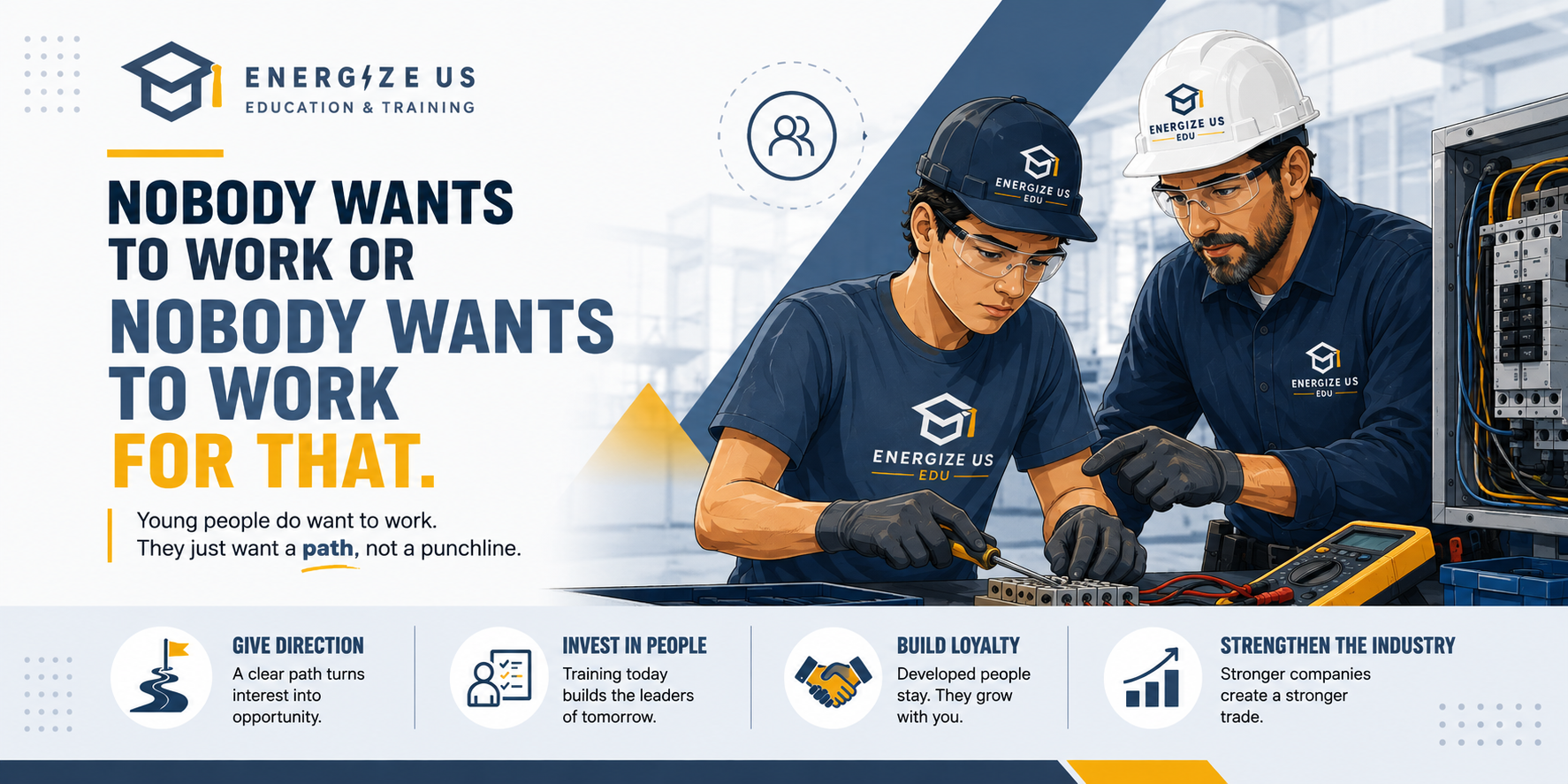

Electrical contractors can make hiring and retention more effective by giving people clear expectations, consistent mentoring, and a visible path to develop their skills. Here is why the experience inside the company matters as much as the job advertisement.
I keep hearing the same thing from Contractors.
Nobody wants to work anymore.
And I get why people say it. Hiring is frustrating. You post the job. You ask around. You try to find someone with experience. You need help now, not six months from now.
But the more we talk to people in this industry, the more I think that line is only half true.
Because young people do want to work.
They just do not want to walk into a company where the whole plan is, do what I did, take the yelling, figure it out, and maybe one day you will be good.
That worked for some people. I am not taking that away from anybody.
A lot of great electricians were built the hard way. A lot of this industry was built by people who had no choice but to learn on the job, keep their head down, and push through.
But just because it built you does not mean it is the best way to build the next person.
That is where I think the disconnect is.
We see young people interested in the electrical trade all the time. They are watching.
They are asking questions. They want to know if this is a real career. They want to know if it can change their life. They want to know if they can make money, learn something valuable, and build a future with it.
That does not sound lazy to me.
That sounds like someone looking for direction.
But then they get around some contractors and the first message they hear is basically, back in my day we just worked and did not complain.
And I understand where that comes from.
But to a young person, that does not sound like leadership.
It sounds like a warning.
It sounds like there is no plan.
It sounds like if they come work for you, they are going to be thrown on a jobsite, expected to know things nobody taught them, and then get blamed when they do not know it.
That is not how you build a workforce.
That is how you lose people before they ever get good.
The funny part is every contractor is looking for the same person.
They want someone experienced, reliable, skilled, clean, safe, professional, and ready to go.
Of course they do!
But so does every other contractor.
That person is already working somewhere. And if they are good, they know they have options.
So at some point, we have to stop asking where all the good electricians are and start asking who is actually building them.
Because waiting for the perfect electrician to apply is not a strategy. It is hope.
And hope does not solve a labor shortage.
The companies that are going to win are the ones that stop treating training like an inconvenience.
I know training slows things down.
I know it takes time.
I know the experienced guy does not always want to explain the same thing again.
I know a mistake on a job costs money.
But so does turnover.
So does constantly hiring.
So does losing good people because nobody gave them a reason to stay.
That is the part of this conversation that does not get talked about enough.
Good workers are not just begging for jobs anymore.
They are looking at the company too.
They are looking at how people are treated. They are looking at whether there is a future. They are looking at whether the owner only talks about loyalty when they need something. They are looking at whether the company actually develops people or just complains when people are not already developed. And honestly, I do not blame them.
If somebody is going to give you their time, their body, their energy, and their years, they want to know it is going somewhere.
That is not entitlement.
That is common sense.
This is where the industry has a real opportunity.
Because the electrical trade can still change somebody’s life.
It can give a young person a skill, a career, a license, a way to provide, and eventually maybe even a business of their own.
But we have to tell that story better.
And more than that, we have to make the experience match the story.
You cannot say this trade has a future and then bring someone into a company that is stuck in the past.
You cannot say young people need to learn and then have no patience to teach.
You cannot say nobody wants to work when the real issue might be that nobody wants to work in a place where there is no path.
That is the conversation we need to have.
Not to bash contractors.
Not to act like the younger generation has it all figured out.
They do not.
But neither does the old way.
The future of this trade is going to belong to the companies that can meet people where they are and still hold them to a high standard.
Because both things can be true.
You can expect hard work and still give people direction.
You can teach discipline without treating people like they are disposable.
You can respect the old school without being trapped by it.
And you can build the next generation without pretending the last generation did everything wrong.
From what we see, the interest is there.
The young people are watching.
The question is, when they look at this industry, are they seeing a future they want to be part of?
Or are they seeing a version of work they already know they do not want?
That might be the real hiring problem.
For a structured approach to developing your crew, explore company-sponsored electrical apprenticeship training or discuss your training needs with Energize Us EDU.
For support with the systems and leadership behind a growing business, see our contractor development program.
Instagram • Facebook • LinkedIn • Website • Youtube
— The Energize Us EDU Team