
Grounding and bonding mistakes in data centers can shut down entire operations. Learn the NEC requirements electricians must understand to install, inspect, and protect mission-critical infrastructure the right way.
Grounding and Bonding in Data Centers: What the NEC Requires
Data center electrical installations demand precision. A single grounding error can compromise equipment protection, create personnel hazards, and trigger costly shutdowns. The National Electrical Code provides clear minimum standards through Article 250 (Grounding and Bonding), Article 645 (Information Technology Equipment), Articles 700 and 701 (Emergency and Legally Required Standby Systems), and Article 708 (Critical Operations Power Systems). These aren't suggestions—they're the baseline requirements that separate professional installations from liability exposures.
Article 250 establishes the framework for grounding electrode systems, bonding paths, and equipment grounding conductors. In data centers, this means coordinating grounding between service equipment, separately derived systems like UPS units and generators, and all metal enclosures housing critical IT loads. The grounding electrode system must be installed per 250.50, typically incorporating building steel, concrete-encased electrodes, ground rings, and driven rods into a unified system with resistance verified and documented.
Article 645 applies specifically to information technology equipment rooms and requires a dedicated grounding reference point. This article mandates disconnecting means, HVAC interlocks, and specific wiring methods under raised floors. Section 110.3(B) demands strict adherence to manufacturer instructions for all equipment, while 110.26 ensures adequate working space around electrical equipment—critical when maintenance must occur while systems remain energized. Article 310 governs conductor sizing, ampacity adjustments, and temperature ratings. Article 215 addresses feeder requirements, essential when distributing power through multiple levels of redundant distribution. Every electrician working mission-critical infrastructure must know these articles cold.
Understanding Article 645 and Critical Data Center Grounding Requirements
Article 645 exists because data centers aren't typical commercial spaces. These environments house sensitive electronic equipment operating 24/7 with zero tolerance for power quality issues or ground potential differences. Section 645.15 specifically addresses grounding, requiring all exposed non-current-carrying metal parts of information technology equipment to be grounded in accordance with Article 250. This means cable trays, ladder racks, equipment frames, raised floor systems, and cable shields must maintain continuous bonding paths back to the grounding reference.
The information technology equipment room itself must comply with 645.10, which permits specific wiring methods under raised floors when proper fire protection and ventilation exist. Power distribution units, remote power panels, and branch circuit wiring must follow these requirements while maintaining proper overcurrent protection and conductor sizing. The disconnect required by 645.10 must be readily accessible, clearly marked, and control both the electronic equipment and HVAC systems serving that space.
Critical operations power systems covered under Article 708 take these requirements further. When a facility qualifies as a critical operations power system—typically Tier III or Tier IV data centers—additional commissioning, documentation, and risk analysis become mandatory. This includes coordination studies, arc flash analysis, maintenance protocols, and operator training. Grounding system design must account for fault current magnitudes, clearing times, and touch/step potential under all operating conditions including generator-only operation, utility paralleling, and multiple source configurations.
Bonding Techniques That Protect Equipment and Personnel in High-Tech Environments
Bonding in data centers serves two critical functions: creating a low-impedance fault current path and minimizing voltage differences between conductive surfaces. Proper bonding techniques start with the main bonding jumper at the service equipment, sized per Table 250.102(C)(1) based on the largest ungrounded service conductor. From there, system bonding jumpers connect separately derived systems like transformers, UPS systems, and generators back to the grounding electrode system.
Equipment bonding jumpers must be installed per 250.102(D), sized according to the overcurrent device protecting the circuit. In data centers with parallel UPS configurations, multiple transformers, and redundant distribution paths, this means every metallic raceway, cable tray, busway housing, and equipment enclosure requires proper bonding. Telecommunications bonding infrastructure (TBI) must integrate with the electrical grounding system, typically through a telecommunications main grounding busbar (TMGB) bonded to the electrical service grounding electrode system.
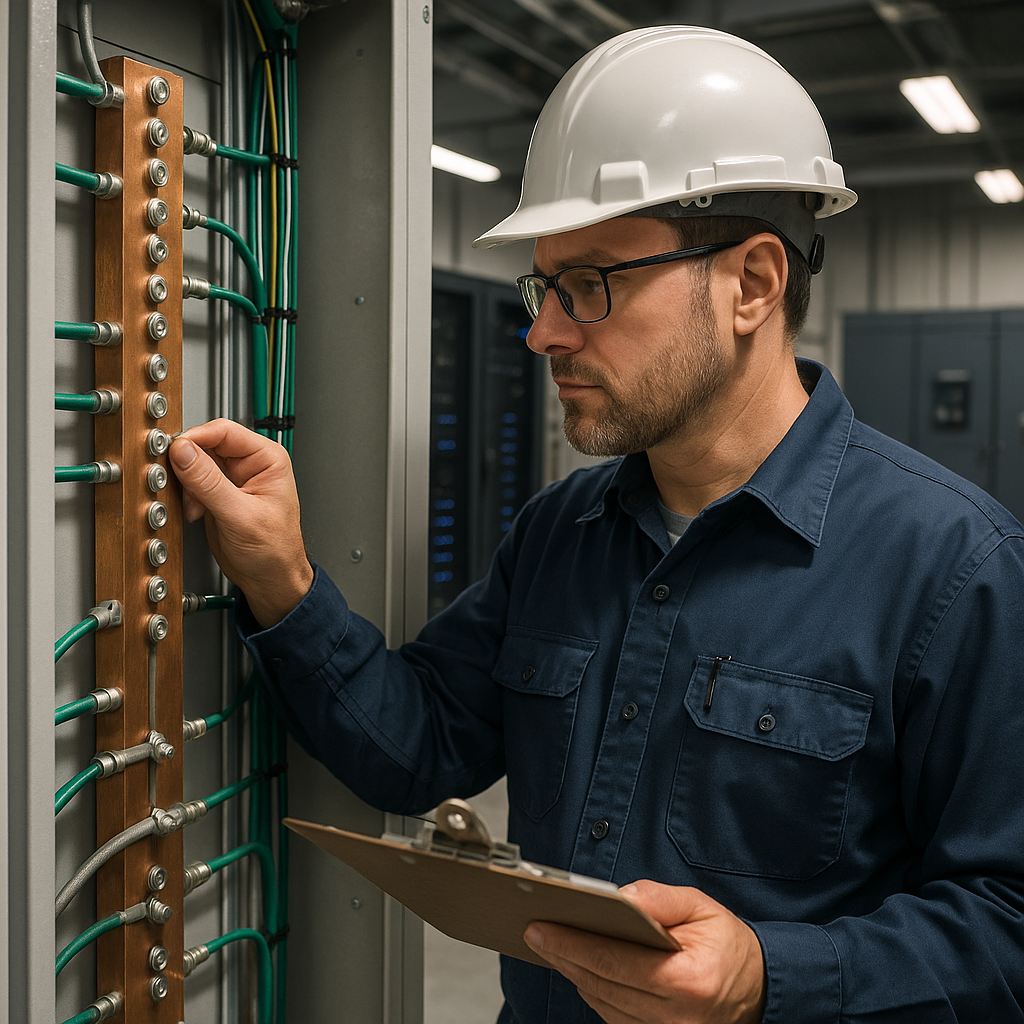
Raised floor systems present unique bonding challenges. Structural steel floor supports, stringers, and panels create a network of metal components that must be bonded to prevent potential differences. Bonding straps sized per 250.102 should interconnect structural components at regular intervals, with connections to the building grounding grid. Cable tray systems require bonding at every section joint using listed connectors, with bonding jumpers sized appropriately. Rack-mounted equipment needs individual equipment grounding conductors run with circuit conductors back to the source, not daisy-chained rack-to-rack. These details matter when fault currents need paths measured in milliohms, not ohms.
Common Code Violations Electricians Make in Data Center Installations
Even experienced electricians make critical errors in data center environments. The most common violation involves relying on structural connections for equipment grounding rather than installing properly sized bonding conductors. Metal-to-metal contact between cable tray sections, rack frames, or equipment chassis does not constitute code-compliant bonding. Every connection requires listed hardware torqued to manufacturer specifications with bonding jumpers installed where structural breaks occur.
Another frequent mistake involves improper grounding electrode conductor sizing and routing. Section 250.64 requires protection for grounding electrode conductors, continuous runs without splices (with specific exceptions), and proper termination methods. Electricians sometimes undersize grounding electrode conductors, fail to protect exposed portions, or create unnecessary splices. In data centers with multiple separately derived systems, each requires its own grounding electrode conductor connected to the common grounding electrode system unless tap rules in 250.30(A)(6) are properly applied.
Neutral-to-ground bonding errors create dangerous conditions and equipment damage. Only one neutral-to-ground bond should exist in any separately derived system—typically at the source. When electricians install bonds at both the UPS output and downstream panels, or fail to install the required bond at the separately derived source, ground fault current paths become unpredictable. This creates potential differences, nuisance tripping, and equipment malfunction.
Documentation failures represent another category of violation. Section 110.22 requires field-applied markings for circuit modifications. In data centers, this extends to one-line diagram accuracy, as-built drawing updates, grounding system test documentation, and equipment labeling. Inspectors and operations staff must be able to trace power paths, identify disconnect locations, and verify grounding integrity through proper documentation. Installations completed without these records fail to meet professional standards regardless of physical installation quality.
Testing and Documentation Requirements Every Professional Must Follow
Grounding system testing begins before energization and continues throughout the facility lifecycle. Ground resistance testing per manufacturer specifications and local AHJ requirements must verify the grounding electrode system meets resistance values, typically 25 ohms or less unless lower values are specified. Testing must be performed using proper three-point fall-of-potential methods or approved clamp-on instruments, with results documented and submitted with permit closeout packages.
Continuity testing verifies bonding integrity throughout the installation. Electricians should measure resistance between grounding points, equipment frames, cable tray sections, and the main grounding electrode conductor. Readings should indicate milliohm-level connections, not fractional ohms. Any elevated resistance indicates poor connections requiring immediate correction before energization. Insulation resistance testing (megger testing) on all conductors prevents energization of damaged cable that could create ground faults.
Ground fault testing confirms protective devices operate as designed. This includes verifying ground fault relay settings, testing ground fault circuit interrupter operation, and performing end-to-end fault current calculations to ensure clearing times meet Article 250 requirements. Equipment grounding conductor sizing must support fault current magnitudes and clearing times per 250.122, with calculations documented in engineering records.
Post-installation documentation packages should include: grounding electrode system test results, bonding continuity measurements, insulation resistance test reports, protective device settings and coordination studies, as-built one-line diagrams showing all grounding connections, equipment grounding conductor routing, separately derived system bonding locations, and photographic evidence of critical connections. Arc flash analysis results, equipment labeling per NFPA 70E, and maintenance procedures complete the documentation set. These records aren't administrative overhead—they're the foundation for safe operations, efficient troubleshooting, and future modifications. Without proper documentation, even a perfect installation becomes a liability during emergency response or system expansion.
Professional electricians understand that installation represents only phase one. Maintenance protocols must include thermal scanning of grounding connections, torque verification on critical bonds, ground resistance retesting at defined intervals, and continuous monitoring of ground fault protection systems. Data center electrical infrastructure demands this level of discipline. The NEC provides the minimum framework. Professional execution and documentation separate infrastructure electricians from installers.