Electrician How-To Lesson · Electrical contractors and crew leaders
When a job frustrates you, start by naming what happened, separating facts from assumptions and comparing your options before making a lasting business decision. Then choose one change you can explain, assign it to someone and set a date to review it.
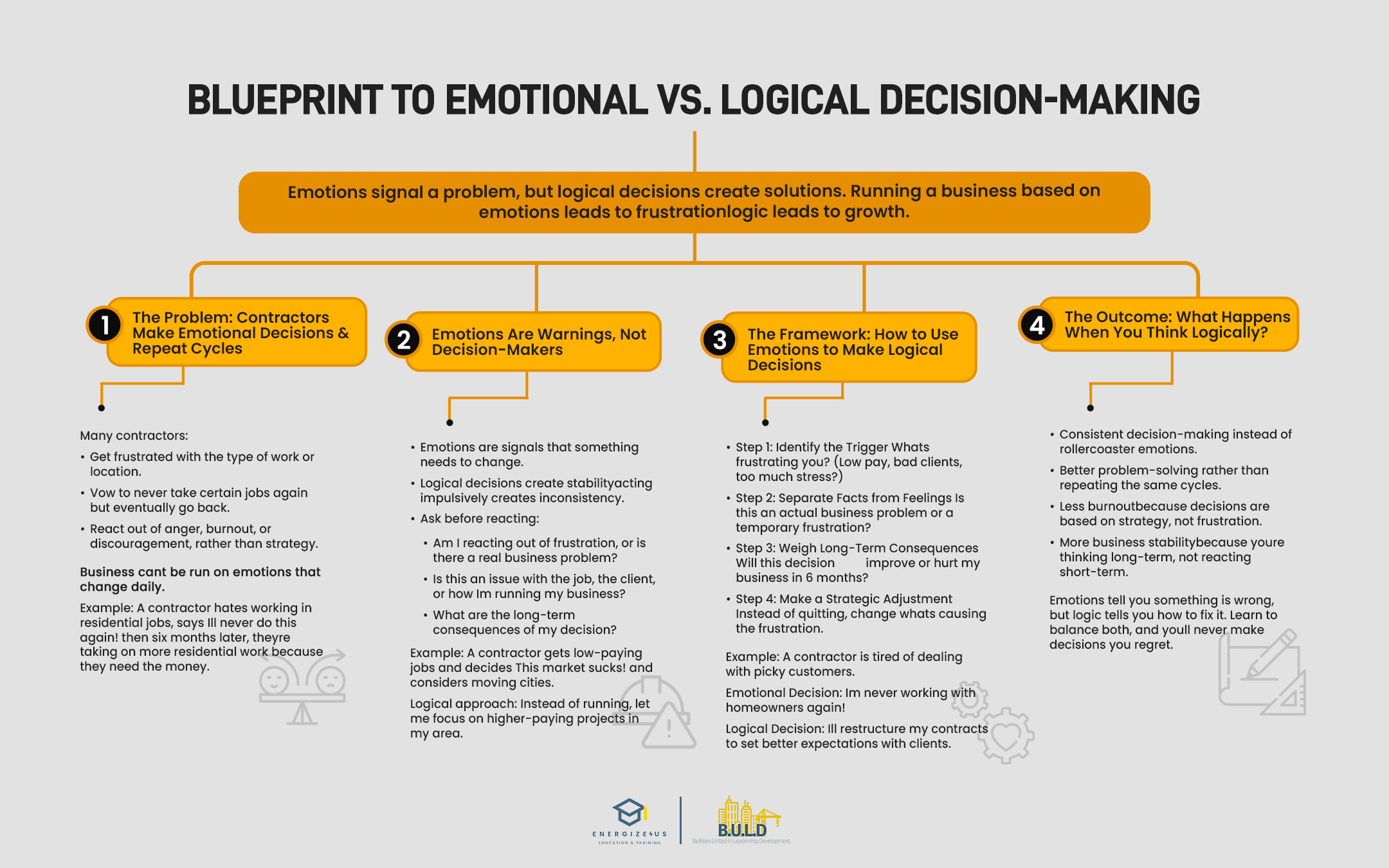
That is the practical purpose of our Blueprint to Emotional vs. Logical Decision-Making: give the frustration somewhere useful to go.
Our original blueprint uses an illustrative contractor who gets frustrated with residential jobs and decides to stop taking them. Months later, the contractor accepts similar work because the business needs revenue. The frustration returns because the way the work is selected and managed has not changed.
This is a teaching example, not a claim about a particular customer or an event from my own business.
You can understand the reaction. After a difficult day, changing the entire business can sound easier than looking closely at what went wrong. But before you rule out a customer type, a market or a service, ask: what specifically caused the problem?
Was the work underpriced? Was the scope unclear? Did someone promise a date before checking the schedule? Did the crew arrive without the information it needed?
Those answers lead to different decisions.
Write down the event that got your attention. Keep it specific enough that another person could check it.
“This customer is impossible” is a conclusion. “The customer expected work that was not listed in our written scope” identifies something you can investigate.
You may still discover that the project or customer is a poor fit. The point is to reach that decision using what happened, rather than letting one difficult conversation explain everything.
For an electrical crew leader, the same habit applies to a missed assignment. First establish what was communicated, what the person understood and what prevented completion. Do not replace those questions with a label about the person.
Use three short headings in your notes:
The reaction deserves attention. It may point to a real problem. Keeping it separate helps you avoid treating an assumption as evidence.
For example, a slow response could reflect unclear responsibility, a missed message or a genuine lack of capacity. Each needs a different response. Check before building a new policy around your first explanation.
The original blueprint asks you to consider the longer-term consequences of a decision. Put at least two realistic options beside each other.
Suppose an illustrative contractor keeps losing time to scope questions. One option is to stop offering that service. Another is to improve the pre-job scope review and confirmation process, then evaluate whether the problem changes.
Ask what each option requires from the customer, crew and office. What work would it remove? What responsibility would it add? What information would make you reconsider?
Use your own records. If pricing is involved, work through the electrical job pricing lesson. A competitor’s rate will not tell you what your own process is costing you.
Choose a next action small enough to carry out and clear enough to evaluate. “Communicate better” leaves everyone guessing. “Before scheduling the next job, confirm the scope, responsible person and next update in writing” gives someone a defined task.
Identify the owner and review date. Then decide what evidence you will look at. Did the customer confirm the same scope? Did the crew receive the missing information before arriving? What remained unclear?
The result may tell you to keep the change, revise it or make a bigger decision. You do not need to pretend the first adjustment will solve everything.
Download the original Energize Us EDU decision-making graphic.
The original artwork is preserved. Treat its outcome statements as teaching prompts, not guarantees that a framework prevents regret or produces a particular business result.
Using the graphic, write one decision note today:
This written exercise applies the original framework. It is provided here in the lesson, not presented as a separate worksheet already inside the download.
No. Respond promptly to immediate safety concerns through the required procedures. This lesson addresses business decisions; it does not replace electrical safety procedures, supervision or emergency action.
Review whether the action was completed and whether it addressed the actual cause. Repeating an instruction will not necessarily fix a missing resource, unclear handoff or unrealistic plan.
Use the customer communication lesson to make the next agreement clear. For more contractor-development learning, explore BULD.
I’m Wilson Matthew Betances, and my mission is simple: Building the People Who Build Things. Take one thing from this lesson and put it to work. If it helped, keep learning with us.